The Sacrificial Tundra, The Lunch Box Hunt, and Why the Nightfly is Still on the Air

We spend the first half of our lives collecting things. Records, trucks, miles and memories. We spend the second half learning how to let them go without losing the pieces of ourselves attached to them.
This past Fourth of July weekend, I found myself staring down the barrel of a classic dad dilemma. My oldest son, Ryan, was stranded in Charlotte with a dead Jeep, a looming Monday morning work shift, and a bank account that didn't need the bruising of a massive new car down payment. The Jeep was pushing 200,000 miles and refused to start. Enter the sacrificial lamb: my 2006 Toyota Tundra XSP. The last year of the smaller body style, 20" BBS polished aluminum wheels, and the back glass that drops all the way down. With all 5 windows down, It was like driving the old sport coupe's of the 50's.
I bought that truck brand new. For twenty years, it was the logistical spine of our family. It carried the boys to school. It trailered my '56 Nomad back and forth during the long, greasy resurrection of the family wagon. It hauled boats to the lake. Lately, it had been sitting in the driveway, hooked to a battery tender, moved just enough every weekend to keep the rubber from flat-spotting. A monument to where we’d been. But a driveway dweller doesn't keep your kid safe on the interstate. So, I pulled the trigger. We traded the Tundra to get Ryan into something dependable.
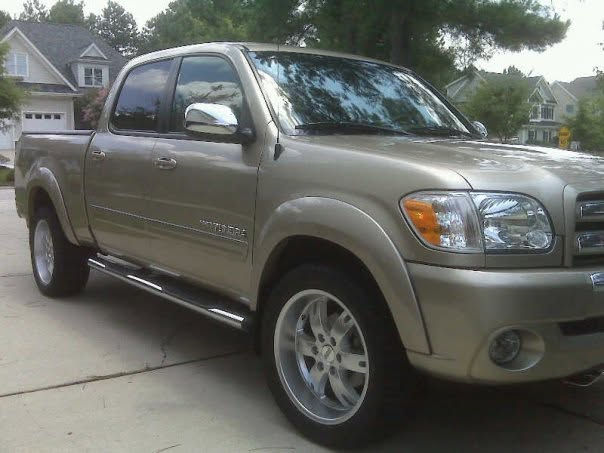
When I went back to Charlotte the following weekend to dispose of the resurrected Jeep at Carmax, there she was. My Tundra was still sitting on the lot! A lot employee had already claimed her before the auction truck could steal her away. Smart kid. He knew a truck that had been babied for 20 years and barely cracked 100k miles was a unicorn. It was a punch to the gut to see her, but it was the right move. We shook hands with the past, watched the Wrangler get rolled away, which was a gut punch for Ryan, and walked off the lot with a heavy cloud hanging over us. To clear the emotional windshield we headed over to a local Charlotte legend: Lunch Box Records.

The moment we walked in, the mood changed. The place was alive. There must have been maybe thirty people deep, shoulder-to-shoulder, flipping through the bins with that quiet, intense focus only vinyl junkies understand. I started flipping, and then, there it was. The album that has sat near the absolute top of my want-list since this blog launched last October: Donald Fagen’s 1982 masterpiece, The Nightfly.

I pulled it from the bin like it was made of glass. The jacket had that beautiful, honest ring-wear from decades of being slid in and out of a shelf. The inner sleeve had a tiny tear, but the record inside was immaculate. I brought the jacket up and took a hit of that musty, aged cardboard scent, my personal internal barometer for a record that has lived a real life. I flipped it over to check the deadwax. No Robert Ludwig "RL" initials, but the vinyl itself was clean as a whistle. For 25 bucks, it wasn't leaving my hands.
Every workday at my Durham office down on old Tobacco Road, I look out the window and see the vintage Chesterfields sign painted on the brick building next door. I love the line I've got plenty of java and some Chesterfields Kings. It’s from Fagen’s title track, a song about a solitary, late-night disc jockey broadcasting from the foot of Mt. Belzoni.

Holding that jacket, the irony hits like a late-night station ID. For a significant stretch of my younger life, I was that guy. I lived the Nightfly existence. The glow of the console meters, the steaming mug of coffee, the smoldering cigarette, the stack of albums, and the solo shift talking into the dark to keep the night-shift workers, young lovers and long-haul truckers company.
Back home in the Groove Den, dropping the needle and letting the sound wash out of the Klipsch felt like a baptism. The Nightfly is the ultimate audio balm for looking back without getting swallowed by regret. Track one, Side one, I.G.Y. hits you with a wave of mid-century optimism, a world of solar-powered cities and clean choices. Fagen was looking back at his 1950s youth from the cynical dawn of the 1980s, wrapping his nostalgia in pristine digital audio.
We make a lot of trades as the calendar flips. We trade the late-night broadcast tower for a daytime office view. We trade a cherished, battle-tested Tundra to make sure our son is safe on the highway. We say goodbye to old friends, hoping the memories don't flat-spot like old rubber tires in the driveway. The truck & Wrangler are gone, and the radio days are in the rearview. But really the only thing that matters is the music plays on, the boy is safe, and the Nightfly is still on the air.

Retro Spin Liner Notes
The Production Powerhouse
Engineered by the legendary Roger Nichols and produced by Gary Katz at Warner Bros. Recording Studios in Burbank and Soundworks in New Yo
rk. The Nightfly is a historical landmark as one of the very first fully digital, large-scale pop recordings, tracked on a 3M 32-track digital system. Fagen’s obsessive perfectionism resulted in an album so sonically flawless that audio engineers still use it four decades later to tune high-end studio monitors and audiophile home systems.
The Players
Donald Fagen stepped away from Walter Becker to handle lead vocals, keyboards, and the overarching conceptual vision.
He surrounded himself with an elite studio cast, including Larry Carlton, Dean Parks, and Rick Derringer on guitars.
Marcus Miller and Anthony Jackson anchored the low end on bass.
Michael Brecker delivered soaring saxophone lines.
Jeff Porcaro of Toto provided the immaculate, metronomic drum pocket on I.G.Y. and Green Flower Street.
The Radio Stats
While The Nightfly was a critical darling and achieved Platinum status, its sophisticated jazz-pop styling yielded distinct hits across multiple formats.
The album itself peaked at Number 11 on the Billboard 200 chart.
The lead single, I.G.Y. (What a Beautiful World), hit Number 26 on the Billboard Hot 100 and went all the way to Number 1 on the Mainstream Rock tracks chart, becoming an absolute staple of Adult Contemporary radio playlists in the fall of 1982.
Follow-up single New Frontier peaked at Number 34 on the Hot 100, driven by an innovative music video that became an early MTV classic.


Comments