Yacht Rock and the King of Smooth

Welcome to the Groove Den. Fix yourself a Harvey Wallbanger, ignore the gentle hum of the harbor outside, and let’s get into it.
There’s an old, tired radio joke that’s been floating around the breakroom since 1976: Michael McDonald makes everything better—except the Doobies.
As someone who spent a decade plus behind the glass at AC stations, I can tell you that’s a load of elitist garbage. The purists wanted their biker-boogie and Black Water singalongs forever, but McDonald didn’t break the Doobie Brothers; he rebuilt them into a high-performance, velvet-lined machine. He took a band that was running out of gas and handed them the keys to a spaceship.
The current resurgence of Yacht Rock—that cooler packaging of the soft rock I played into the ground in the 90s—is more than just a trend. It’s a return to a standard of engineering. For years, this music was kicked to the curb by the hipper, over-compressed versions of Hot AC and Top 40. But you can’t keep a good Rhodes piano down!

To understand this genre, you have to go back to 2005 and the web series that gave it a name. JD Ryznar and "Hollywood" Steve Huey gave us the vocabulary, and a lot of laughs, but I lived the reality. They identified the essential truth: Yacht Rock is a very specific vibe. It’s high-budget, Los Angeles studio perfectionism. It’s the sound of a million-dollar recording budget meeting a room where nobody was allowed to be out of tune.
While the term was born on the early internet, SiriusXM is what turned it into a year-round lifestyle. They first launched Yacht Rock Radio as a summer-only pop-up channel in 2015. It was supposed to be a seasonal novelty, but the data didn't lie—people weren't just listening; they were obsessed. By 2017, the demand was so high they gave it a permanent home on Channel 311.
The ultimate validation arrived with the HBO Original Documentary, Music Box: Yacht Rock: A Dockumentary. The film does exactly what we do here in the Groove Den: it strips away the irony and respects the sheer, unadulterated craftsmanship of the era. This wasn't just breezy pop for the wealthy; it was a sophisticated, heavily R&B-influenced fusion of jazz and rock.

The documentary highlights a brilliant observation from Questlove, who describes the genre as perfect "sitting-down dancing" music. He hits the nail right on the head. These records earned their legendary status because you cannot fake the kind of studio telepathy shared by the titans of the format.
Think about the unyielding standards of the era. You had Donald Fagen and Walter Becker of Steely Dan driving session musicians to the brink of insanity just to capture a flawless, microscopic groove. There is Kenny Loggins, the undisputed high-priest of the high-octane soundtrack anthem, carving out hooks that defined a decade. And, of course, Christopher Cross, an unknown Texan who stepped into the studio with LA's finest players and walked away sweeping the 1981 Grammy Awards. Sitting right at the center of this entire web, acting as the ultimate connective tissue, was Michael McDonald.
Seeing a band like Yacht Rock Revue pack out The Ritz in Raleigh proves that people are starving for this music and the simpler times they represent. There’s something visceral about a room full of people singing in unison and hitting every note on Baker Street—even if half of them are wearing cheap captain's hats and sipping on a bottle of Asti Spumante. It’s a little cheesy, sure, but isn't that what smooth is all about?
I felt the weight of that history during my final trip to Bull City Records. It’s a Thursday afternoon in Durham and the store is closing for good on Sunday. Watching a shop like Chaz’s wind down is a brutal reminder that Amazon and online ordering are killing the soul of our economy. The bins were picked over, the shelves were skeletal, and the hunt felt more like a wake.
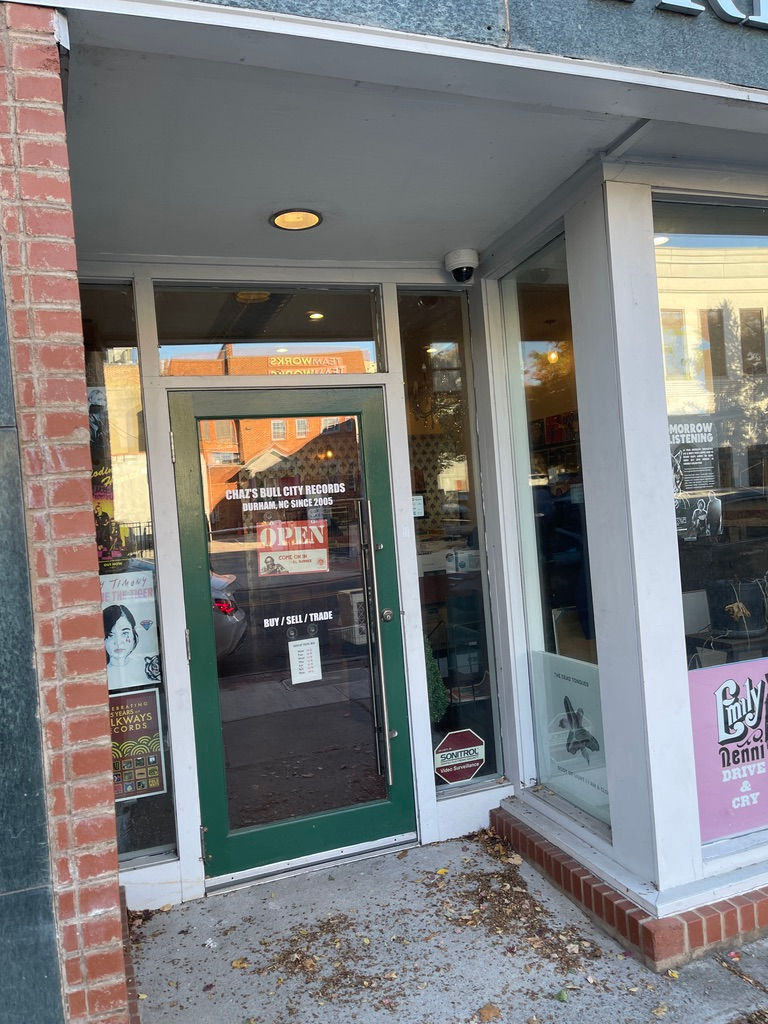
I managed to snag a weird, self-titled Clapton album from 1973 for five bucks—a Polydor relic from his "dark years" featuring Derek and the Dominos tracks. It’s a fascinating snapshot of a man falling apart while playing the best guitar of his life, but it wasn't the prize of the day.
The real score happened at the register. I caught Chaz stickering and checking in a finmal trade-in. I asked if I could go through the stack on the counter. Then five records down, I flip to a near-perfect 1978 pressing of Minute by Minute from the Doobie Brothers. Right On!
Back home in the Den, I didn't just play it; I hosted it. Dropping the needle on a clean '78 press and hearing it through the Klipsch is fantastic and takes me back to the air-chair and singing along to every word.

In the radio booth, I played these tracks until the carts wore out, but modern digital streams often flatten the dynamics. On this wax, you can hear the physical space in the studio. You hear the "air" around the snare and the way McDonald’s vocals sit perfectly in the pocket. When What a Fool Believes kicks in, I understand it’s not just a song; it’s perfection in syncopation—that bouncy, West Coast shuffle that defines the era.
So, pour a glass of something cold, unbutton the shirt to half-way, and let the King of Yacht Rock take the wheel. After all, life is too short for low-fidelity and rough edges.
Retro Spin Liner Notes: Minute by Minute (1978)
The Production Powerhouse
Produced by Ted Templeman at Warner Bros. Recording Studios in North Hollywood. Templeman was the architect of the California Sound, known for capturing a specific blend of rock muscle and polished pop sheen that became the industry standard for the late 70s. The sessions for What a Fool Believes became legendary for the band's obsessive, multi-take pursuit of the perfect rhythmic pocket.
The Players
Michael McDonald: Lead vocals, keyboards, synthesizers
Patrick Simmons: Guitars, vocals
Jeff "Skunk" Baxter: Guitars (his final studio outing with the band)
Tiran Porter: Bass, vocals
Keith Knudsen: Drums, percussion, vocals
John Hartman: Drums
Special Guests: Kenny Loggins (co-writer on What a Fool Believes), Bill Payne of Little Feat (keyboards), and Nicolette Larson (backing vocals).
The Radio Stats
The album hit Number 1 on the Billboard 200 and remained a staple of the format for years.
What a Fool Believes: Number 1 Billboard Hot 100 (1979)
Minute by Minute: Number 14 Billboard Hot 100
Dependin' on You: Number 25 Billboard Hot 100


Comments