Behind the Runes: Why Led Zeppelin IV Still Shatters the Dial
- Jim Chapin
- 4 days ago
- 5 min read

I'm not going to apologize for loving Stairway to Heaven.
There are those that love to dismiss it as the ultimate classic rock cliché. The song everyone loves to hate. The song guitar shops banned because every kid with a budget Stratocaster tried to fumble through the intro. But walk into the Groove Den, drop the needle on Side One, Track Four of a flawless 1977 Presswell reissue, and turn the lights down. The moment the surface noise fades into that solitary A-minor acoustic chord, the cynicism evaporates.
The track is an architectural masterpiece. For nearly five minutes, Jimmy Page builds a fragile scaffolding of acoustic guitars, recorders, and Robert Plant’s understated vocal. You’re leaned in, tracking the stereo separation on the speakers, waiting for the floorboards to move.
Then comes the 4:55 mark. John Bonham hits that slow-burn, syncopated entry on his Ludwig kit. It isn’t just a drum cue; it alters the gravity of the room and requires and immediate crank of the volume. It’s the single greatest entrance in rock history, and if it doesn’t give you chills, it’s time to check your pulse or buy a better amp.
For a veteran radio guy who longs for the days of the AOR format, IV is the holy grail of Album-Oriented Rock. I can easily slip back to the days of KLOL in Houston. Think about the sheer audacity of this record. Zeppelin was coming off the acoustic left turn of III, and the critics were sharpening their knives. The band's response? They delivered an eight-minute epic, flatly refused to edit it down for a 45 RPM radio single, and put it on an album with zero text on the jacket. No band name, no title, no catalog number. Just some hand-drawn runes and a painting of an old man carrying a bundle of sticks.
Atlantic Records executives probably had collective heart attacks, but Zeppelin understood something the algorithm never will: when the music is an absolute freight train, the audience will find you.

On the airwaves, Stairway became an institutional monopoly, but the true genius of IV is that it isn’t a one-trick pony. Look at the real estate surrounding it. You get the staggering, brain-bending time signatures of Black Dog leading into the primal, high-octane grease of Rock and Roll. Then you flip the slab and get the driving mandolin sunshine of Going to California and the hazy, menacing stomp of Misty Mountain Hop. It is a flawless example of album pacing from an era when sequencing was a fine art, not a shuffle button.
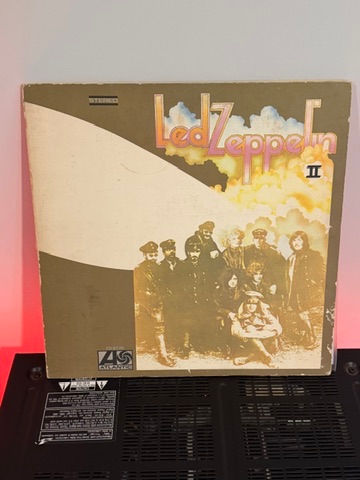
You know, when I first set out on this path of reclaiming the vinyl from my youth, painfully rebuilding a collection I never should have let go of in the first place, I never would have predicted I'd get re-hooked on Zeppelin. But this past year has changed things. When you are forced to sit down and physically choose which albums you want to hold in your hands again, the heavy hitters start demanding their space. And honestly, I'm completely fine with that. This is my hunt. This is my collection. I don't care if adding Led Zeppelin IV to the shelf feels predictable. I've been able to collect II, IV, and Houses of the Holy Physical Graffiti is on the list yet to find.
The reality out in the local bins is that finding a clean, playable copy of this record today for a reasonable price is a minor miracle. I hit the shops constantly, and I've only seen it out in the wild once or twice. Both times, it was mounted on the wall with a hundred-dollar price tag slapped on the plastic wrapper. It makes sense when you think about it. Most of those original 1971 pressings were absolutely thrashed on cheap ceramic cartridges at high school keggers, or left to warp and melt in the back of a station wagon during a hot July afternoon. They were loved to death. That is what makes stumbling onto a near perfect copy feel like a massive victory.
I snagged this particular 1977 reissue out of the Ancora, New Jersey plant from Alley Cat in Greenville. It's an absolute survivor. The jacket looks like it literally time-traveled from the factory floor straight to the crate. And yes, it possesses that distinct, earthy vintage cardboard smell. Lorraine gives me a hard time when she catches me taking a deep whiff to verify the age, but any true collector knows that scent is the ultimate proof of authenticity. It’s the smell of history. The vinyl itself has some physical meat to it, cut before the early-80s oil crisis forced labels to skimp on vinyl weight. The mid-range is punchy, raw, and exceptionally wide, giving John Paul Jones’ bass lines the necessary muscle to balance out Page’s layered guitar tracks. The subtle, organic pops between tracks are just a gentle reminder that you’re listening to human beings making noise in a room together.

Call it an overplayed cliché all you want, but as the acoustic outro fades into the crackle of the run-out groove, none of that matters. I'm completely engulfed in the analog warmth, left dreaming of a simpler time, a lost highway, and a girl out there with flowers in her hair.
Retro Spin Liner Notes
The Production Powerhouse
The album was produced by Jimmy Page with Andy Johns handling engineering duties. While early sessions began at Island Studios in London, the definitive sonic DNA of the record was captured at Headley Grange, a drafty, three-story Victorian workhouse in Hampshire, England. Utilizing the Rolling Stones Mobile Studio, the band lived and recorded in the house, turning the building's stark architecture into a giant acoustic instrument. Final mixing was completed at Sunset Sound in Los Angeles, injecting a bright, aggressive American radio sheen into the heavy tracks.
The Players
Robert Plant: Lead vocals, harmonica.
Jimmy Page: Electric, acoustic, and pedal steel guitars, mandolin.
John Paul Jones: Bass guitar, electric piano, Mellotron, recorders.
John Bonham: Drums, percussion.
Sandy Denny: The Fairport Convention vocalist shares a haunting, ethereal vocal duet with Plant on The Battle of Evermore, earning her own unique rune symbol on the inner sleeve.
Ian Stewart: The legendary Rolling Stones road manager and boogie-woogie ace contributes the driving piano work on Rock and Roll.
The Radio Stats
Led Zeppelin IV (Album): Released November 1971, it peaked at No. 2 on the Billboard 200, famously blocked from the top spot by Carole King's Tapestry. It log-rolled through the charts for 259 weeks and has been certified 24x Platinum in the US.
Black Dog: Peaked at No. 15 on the Billboard Hot 100 in February 1972.
Rock and Roll: Peaked at No. 47 on the Billboard Hot 100 in April 1972.
Stairway to Heaven: Never officially released as a commercial retail single in the US markets. Despite having no 45 RPM availability, it became the most heavily requested and played track in the history of American FM rock radio, universally cemented at No. 1 on all-time rock track lists worldwide.

Comments